Two Frameworks, Different Purposes
Both the traditional business plan and the business model canvas are tools for planning your business, but they serve different needs at different stages. Understanding when to use each can save you weeks of unnecessary work.
The Business Model Canvas
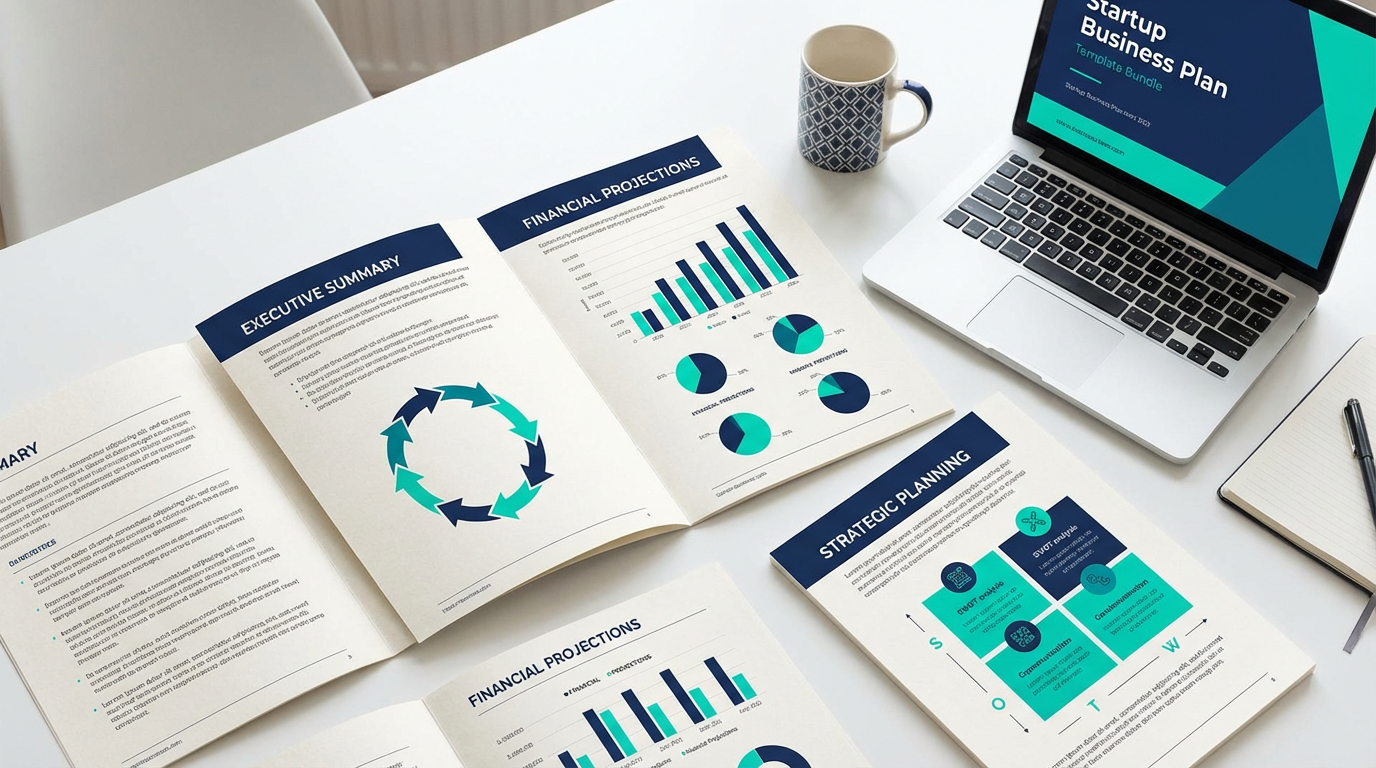
Startup Business Plan Template Bundle
Complete business plan templates for startups — executive summary, market analysis, financial projections, and more.
Created by Alexander Osterwalder, the Business Model Canvas is a one-page visual framework that maps out the nine building blocks of your business:
The 9 Building Blocks
- Customer Segments: Who are your customers? What are their characteristics and needs?
- Value Propositions: What unique value do you offer? Why should customers choose you?
- Channels: How do you reach and communicate with customers?
- Customer Relationships: What type of relationship do you build with each segment?
- Revenue Streams: How do you make money? What are customers willing to pay?
- Key Resources: What assets do you need to deliver your value proposition?
- Key Activities: What critical activities does your business model require?
- Key Partnerships: Who are your essential partners and suppliers?
- Cost Structure: What are your major costs and how do they relate to revenue?
When to Use a Business Model Canvas
- Early-stage ideation: Testing and iterating on your business concept
- Pivoting: Quickly mapping out a new direction
- Team alignment: Getting everyone on the same page visually
- Lean startups: When you need speed over detail
- Internal planning: For your own clarity before committing to detail
Time to complete: 1-3 hours
The Traditional Business Plan
A business plan is a detailed written document that covers every aspect of your business in depth, typically 15-30 pages.
Standard Sections
- Executive Summary
- Company Description
- Market Analysis
- Organization and Management
- Products or Services
- Marketing and Sales Strategy
- Funding Request
- Financial Projections
- Appendix
When to Use a Traditional Business Plan
- Seeking funding: Investors and banks expect formal business plans
- Complex businesses: When you need to detail operations, staffing, and logistics
- Regulatory requirements: Some industries require formal documentation
- Strategic planning: For established businesses planning growth or expansion
- Partnership proposals: When bringing on co-founders or strategic partners
Time to complete: 1-4 weeks
Head-to-Head Comparison
Free: Business Launch Checklist
50 essential steps to launch your business. Get it free.
| Feature | Business Model Canvas | Traditional Business Plan |
|---|---|---|
| Length | 1 page | 15-30 pages |
| Time to create | 1-3 hours | 1-4 weeks |
| Best for | Ideation and iteration | Fundraising and operations |
| Flexibility | Easy to change | Harder to update |
| Detail level | High-level overview | In-depth analysis |
| Financial detail | Minimal | Comprehensive projections |
| Visual | Yes, diagram format | No, written format |
| Audience | Internal team | External stakeholders |
The Right Approach: Use Both
The smartest entrepreneurs use both tools at different stages:
- Start with a Canvas: Map out your initial business concept quickly. Test assumptions with potential customers.
- Iterate on the Canvas: Update it based on customer feedback and market research. Try different configurations.
- Graduate to a Plan: Once your model is validated, expand it into a full business plan if you need funding or want detailed operational planning.
Think of the Canvas as your sketch and the Business Plan as your blueprint.
Our Recommendation
If you are just starting out and do not need funding, begin with a Business Model Canvas. You will move faster, test more ideas, and avoid spending weeks on a plan for a concept that might change.
If you are seeking investors, applying for loans, or planning a complex operation, you need a formal business plan. No shortcuts.
Our Startup Business Plan Template Bundle includes both a Business Model Canvas template and a full business plan template, so you are covered at every stage.
FAQ
Can I use a Business Model Canvas to pitch investors?
Some angel investors and startup accelerators accept it for early-stage pitches. VCs and banks will almost always want a full business plan.
How often should I update these documents?
Update your Canvas whenever you test a major assumption. Update your business plan quarterly or when there is a significant change in strategy.
Are there digital tools for the Business Model Canvas?
Yes, tools like Strategyzer, Miro, and Canva offer digital Canvas templates. But a simple printed template works just as well.