Why Financial Projections Matter
Financial projections are the numeric backbone of your business plan. They translate your business strategy into dollars and cents, showing investors, lenders, and stakeholders that your business model is viable and your growth targets are achievable.
Even if you're not seeking funding, financial projections help you:
- Set realistic goals and milestones
- Identify potential cash flow problems before they happen
- Make informed hiring and spending decisions
- Track performance against your plan
The 3 Core Financial Statements
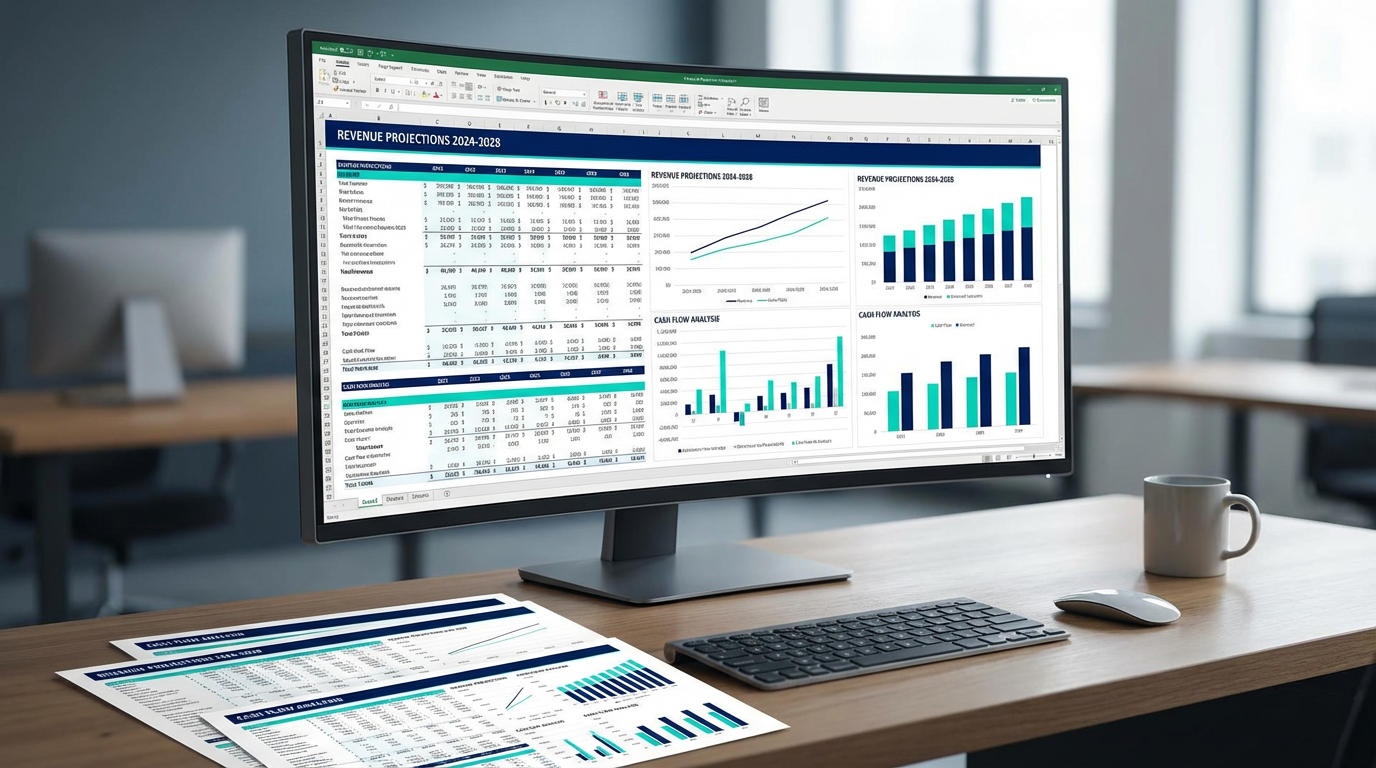
Financial Projection Spreadsheet Kit
Pre-built financial models with revenue forecasts, cash flow projections, and break-even analysis.
1. Income Statement (Profit & Loss)
The income statement shows your revenue, expenses, and profit over a specific period. Key line items include:
- Revenue: All income from sales, services, subscriptions
- Cost of Goods Sold (COGS): Direct costs of delivering your product
- Gross Profit: Revenue minus COGS
- Operating Expenses: Rent, salaries, marketing, software, etc.
- Net Income: Your bottom line profit (or loss)
Key metric: Gross margin (Gross Profit / Revenue) — this tells you how efficiently you deliver your product.
2. Cash Flow Statement
Cash flow is king for startups. Many profitable businesses fail because they run out of cash. Your cash flow statement tracks:
- Operating cash flow: Cash from daily business operations
- Investing cash flow: Cash spent on equipment, assets
- Financing cash flow: Cash from loans, investments, equity
Critical concept: Revenue ≠ Cash. You might record a $10,000 sale today but not receive payment for 30-60 days.
3. Balance Sheet
A snapshot of what your company owns (assets), owes (liabilities), and is worth (equity) at a specific point in time.
- Assets: Cash, inventory, equipment, accounts receivable
- Liabilities: Loans, accounts payable, deferred revenue
- Equity: Owner's investment plus retained earnings
How to Build Your Revenue Forecast
Bottom-Up Approach (Recommended)
Start with your specific business metrics and build up:
- Estimate your addressable customers: How many people could buy from you?
- Conversion rate: What percentage will actually buy?
- Average order value: How much does each customer spend?
- Purchase frequency: How often do they buy?
Formula: Revenue = Customers × Conversion Rate × Average Order Value × Purchase Frequency
Top-Down Approach (Supplementary)
Start with the total market and estimate your share:
- Total market size: $10 billion
- Your serviceable market: $500 million
- Your market share goal: 0.5%
- Projected revenue: $2.5 million
Warning: Top-down projections are less credible because they depend on broad assumptions. Use bottom-up as your primary method.
Common Expense Categories
Free: Business Launch Checklist
50 essential steps to launch your business. Get it free.
| Category | Examples |
|---|---|
| Personnel | Salaries, benefits, contractors, payroll taxes |
| Marketing | Ads, content, SEO, events, PR |
| Technology | Hosting, software, APIs, development tools |
| Operations | Office rent, utilities, insurance, legal |
| Cost of Goods | Manufacturing, shipping, raw materials |
5 Golden Rules for Startup Financial Projections
- Be conservative: Investors see through hockey-stick projections. Start modest and show a clear path to growth.
- Show your assumptions: Every number should be traceable to a specific assumption.
- Project 3-5 years: Most investors want to see at least 3 years.
- Include monthly projections for Year 1: Quarterly for Years 2-3, annual for Years 4-5.
- Plan for scenarios: Build best-case, base-case, and worst-case models.
Key Metrics Investors Care About
- Monthly Recurring Revenue (MRR): For subscription businesses
- Customer Acquisition Cost (CAC): How much it costs to get a customer
- Lifetime Value (LTV): Total revenue from a customer over time
- LTV:CAC Ratio: Should be 3:1 or higher
- Burn Rate: How fast you're spending cash
- Runway: How many months of cash you have left
Skip the Spreadsheet Headaches
Building financial projections from a blank spreadsheet is time-consuming and error-prone. Our Financial Projection Spreadsheet Kit includes pre-built templates with formulas, charts, and industry benchmarks to get you accurate projections in hours instead of weeks.
FAQ
How accurate do financial projections need to be?
They're educated estimates, not guarantees. Focus on showing a logical, defensible path to your numbers.
What if I don't have historical data?
Use industry benchmarks, competitor data, and your own market research to build assumptions.
Should I hire an accountant to build projections?
For a seed-stage startup, you can build them yourself with a good template. For Series A+, consider professional help.